Optimization of a biogas upgrading unit's operation
March 2024
The original paper, slides and figures are in French.
Presented at the 25th congress of the French OR society (ROADEF 2024), in Amiens. It optimizes the operation of a biogas upgrading unit on a real anaerobic digestion site, run with Nevezus as part of the Biogaz-IA project.
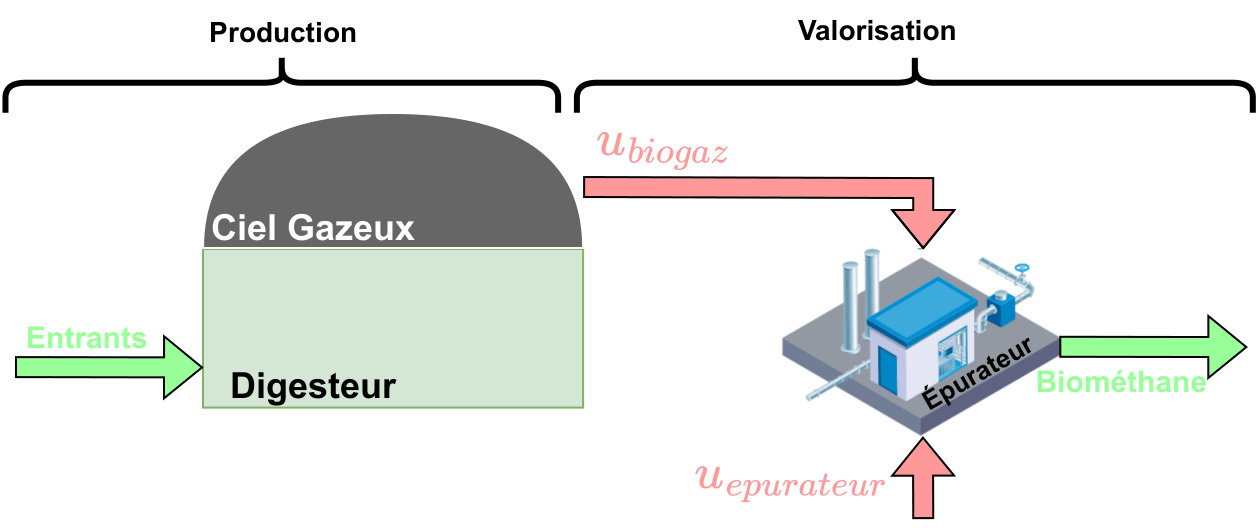
A digester produces biogas, stored in a gas holder and then purified by an upgrading unit before injection into the gas grid as biomethane. The upgrading step is energy-intensive, and its profitability follows the day/night electricity price. The controller decides when to run the unit and at what flow rate, to maximise biomethane revenue while cutting the energy bill.
The problem is a mixed-integer linear program: operational constraints (minimum run times, start-up penalties, gas-holder dynamics) as linear constraints, biogas production smoothed with a rolling median. It runs in a receding-horizon loop (3-day horizon, 10-minute steps, re-solved with HiGHS and SCIP).
This is the applied, MILP-based sibling of my wastewater aeration control work. The goal is the same, optimal control of a real industrial process, reached here through mixed-integer programming rather than stochastic control. The modelling methodology behind the formulation is detailed in the GDR RO&D 2024 talk.
Result
Six weeks of the site’s usual local control against six weeks of the optimizer. The controller held the gas holder at a higher average level (49% of capacity versus 39%) and cut the upgrading unit’s operating cost by about 9%, without extra start-ups.
The full communication (French, “Optimisation du fonctionnement d’un épurateur pour la méthanisation”) is on HAL.
Slides
Joint work with Arnaud Tournier (Purecontrol, IRMAR / SATIE), with Nevezus (Biogaz-IA).