Data assimilation for prediction of ammonium in wastewater treatment plant: from physical to data driven models
August 2025
My main PhD paper, published in Water Research (vol. 282, art. 123673). A wastewater treatment plant removes ammonium () by aeration, its largest energy cost. Spending that energy efficiently means anticipating the load rather than reacting to it. This is the aim of model-based control, which needs a forecast of the ammonium concentration a few hours ahead. Producing that forecast reliably is the foundation the rest of this work builds on.
The paper puts the whole model spectrum on one benchmark:
- white-box physics (ASM1),
- grey-box reductions that keep only the dynamics needed for control,
- black-box data-driven models.
Each model is coupled with sequential data assimilation (Kalman- and particle-type filters) so that sensor readings continuously correct the state. Point accuracy and interval calibration are then compared across the forecast horizon. The estimation machinery behind the grey-box case, a stochastic EM built on a particle filter and a backward smoother, is developed in the ECC 2024 paper.
On the simulated ASM1 benchmark the data-driven approach wins. A nonparametric black-box model (local linear regression with a particle filter) gives the best accuracy and the best-calibrated intervals. The grey-box comes next. The physical white-box is last, and by far the most expensive to fit. A parsimonious model with data assimilation beats both pure physics and pure data, and stays usable on the sparse, noisy sensors of a real plant.
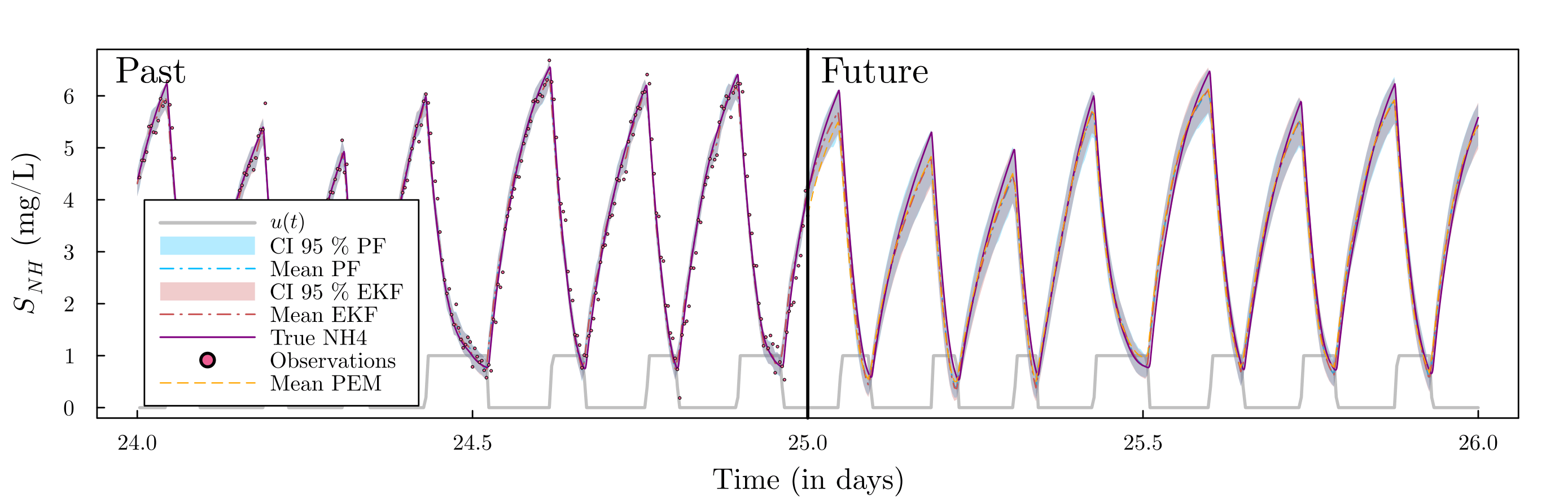
These forecasts are the foundation of the rest of the thread. The uncertainty they carry is dissected in the ROADEF 2025 analysis, and they feed the stochastic dynamic programming controller studied at CANUM 2026. The PhD thesis assembles the two steps, identification by data assimilation then stochastic control, into a single method.
Method, datasets and figures are in the paper. The code is open-source.
Joint work with Roman Le Goff Latimier and Valérie Monbet (Purecontrol, ENS Rennes / IETR, IRMAR).